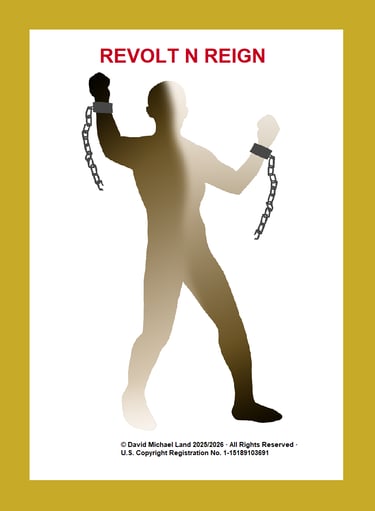
Revolt N Reign Rulebook Overview
This game is dedicated to:
Patriots & players who value depth
Educators & parents who care and believe learning should be engaging.
REVOLT N REIGN exists to teach systems thinking, constitutional principles, and the consequences of unchecked power - through play, not lectures.
REVOLT N REIGN is inspired by history, civics, and the struggle between liberty and power.
Final Truth
Revolt N Reign is not about comfort. It is about awareness, pressure, and choice.
Natural rights are treated as the default state. Control systems must justify themselves through cost. Players always understand why pressure exists.
The Foundational Set is coming. Be part of it from the beginning.
revoltnreign.com/join
Quick Reference Links
Quick Start Guide at revoltnreign.com/quickstart
How to Play Guide at revoltnreign.com/how-to-play
Glossary at revoltnreign.com/glossary
Unconstitutional Acts at revoltnreign.com/symbols-and-ua-subset
Founding Player and Investor Sign-Up at revoltnreign.com/join
© 2026 David Michael Land · All Rights Reserved · U.S. Copyright Registration No. 1-15189103691, effective June 20, 2026
This is the authority document for Revolt N Reign. When a card contradicts this rulebook, the card wins. When this rulebook contradicts the Quick Start or How to Play guide, this rulebook wins. Read what your cards actually say. Build your strategy around what they actually do.
What This Game Is
Revolt N Reign is not a fantasy game. It is not random chaos. It is not a passive engine builder.
It is a pressure-based strategy game where power exists by default, liberty erodes automatically, and victory is earned through action. Three Unconstitutional Acts drain your Liberty Points every turn before you play a single card. The board is compromised from the moment the game begins. Stalling is not a strategy. Adaptation is the only path.
This game is dedicated to players who value depth, educators and parents who believe learning should be engaging, and anyone who understands that the founding documents of the United States are not history - they are architecture.
Design Philosophy
Revolt N Reign is built on five principles that govern every rule and every card in the game.
Pressure is constant. Unconstitutional Acts drain Liberty during their controller's turn without any action required.
Stalling is impossible. Automatic LP loss forces both players to engage.
No pay-to-win scaling. Skill, not card volume, wins games.
Multiple victory paths. Players must respond to threats, not follow scripts.
Systems over single cards. No card wins alone. Positioning and timing matter.
A Note on Historical Sources
Play descriptions in Revolt N Reign are historically inspired adaptations drawn from Founding-era writings and speeches. They are not presented as verbatim quotations but as faithful summaries credited to their original authors when available. Founders' quotations may appear on multiple cards to reflect their deliberate repetition of core truths - liberty, rights, and limits on power - essential to preserving a Republic of freedom rather than a system of privileges.
Components
Each player uses a 60-card deck with three Unconstitutional Act cards removed and placed in the UA Area before play begins. The remaining 57 cards are shuffled to form the Draw Pile. All rules and card effects use the term Draw Pile. Any reference to deck is informal language only and has no separate mechanical meaning.
Each player also uses a Liberty Points tracker starting at 100 and an Independence Points tracker starting at 0.
Pre-Game Setup
Complete all six steps before gameplay begins. Order matters.
Step 1: Place Unconstitutional Acts. Each player places their three UA cards face-up in the UA Area. These cards begin in play. They are never shuffled into the Draw Pile. Never place UAs into the Draw Pile.
Step 2: Shuffle your remaining 57 cards thoroughly. Your opponent may cut your deck.
Step 3: Mulligans. Both players draw seven cards. Each player may mulligan up to two times. To mulligan, shuffle your hand back into your deck and redraw seven cards. Mulligans must occur before turn order is determined.
Step 4: Determine turn order. If one player is under 15 years old at the time of play, they go first automatically. Otherwise roll dice. Highest roll becomes Player 1.
Step 5: Player 2 pre-game equalization. Before Player 1 begins Turn 1, Player 2 may play one zero-IP card from hand. Its effects do not resolve immediately. They resolve during the first Resolve Phase of actual gameplay. This balances the first-mover advantage. No other TCG does this.
Step 6: Set trackers. Liberty Points start at 100. Independence Points start at 0. After drawing opening hands, the remaining Draw Pile contains 50 cards. Gameplay begins.
Deck Construction
Total cards per deck: 60
UA cards (pre-game, separate from deck): exactly 3
Opening hand: 7 cards
Play deck after removing UAs: 57 cards shuffled
Rights cards maximum: 12 per deck, no duplicates
Freedom cards maximum: 3 per deck, no copies
Bills maximum: 3 per deck, no copies
Pillar cards (non-rare, non-petition): any amount allowed including duplicates. No duplicates of Rare or Petition Pillar cards.
Attack and Defense duplicates: up to 4 different card names total, 1 copy each
Starting Liberty Points: 100
Rarity tiers: Common (0-2 IP), Uncommon (3-4 IP), Rare (5-8 IP), Paramount, Immortal, Unalienable
Duplicate rules for Attack and Defense cards only: A deck may include duplicates of up to 4 different total card names chosen from Attack and Defense cards only. For any card name included this way, the deck may contain the unique card and up to 1 additional copy of that same name. Duplicates are determined by card name only, not by effect, text, or function.
The Seven Card Types
Unconstitutional Acts: Automatic pressure. Drain opponent Liberty Points each turn during the controller's Resolve Phase. Three begin in play for each player before the game starts. Never shuffled into the Draw Pile.
Pillars: Resource foundation. Generate Independence Points each turn. Remain in play indefinitely. Cannot be targeted or destroyed unless a card explicitly states so. Pillar IP generation is a core rule effect. One Pillar card may be played from hand per turn. Pillars that enter the battlefield through card effects do not count toward the one-per-turn limit.
Attack: Deal damage to opponent Defense cards and UAs. May only target Liberty Points if the card text explicitly states it. Valid targets are Defense cards, Unconstitutional Acts, other Attack cards via Attack on Attack, and Liberty Points only when stated by the card.
Defense: Protect Unconstitutional Acts by absorbing Attack Damage. Defense cards do one job only. They do not stop Liberty Point loss. They do not protect LP. They do not block UA drain. They do not protect Petitions unless a card explicitly states otherwise.
Rights: One-time powerful actions. Maximum 12 per deck. No duplicates. Resolve once then discard. May deal damage, gain LP, or draw cards. Petitions stay in play unless exiled or removed by a card effect.
Freedom: Unique hybrid cards rewarding timing and foresight. Maximum 3 per deck. No copies. May include Pay X IP abilities.
Bills: Powerful escalating-cost legislative action cards. Maximum 3 per deck. No copies. Played once per turn. After resolving, a Bill returns to hand unless exiled. Each time a Bill returns to hand, its IP cost doubles for all future plays. This cost persists between turns and is tracked by card name. If a Bill is exiled it cannot be played again and no further cost increases occur.
Branches
Branches represent structural philosophies and systems of power, not political factions. They confer no inherent bonuses unless explicitly referenced by a card effect. Every card has one Branch symbol. Exception: Unconstitutional Acts. Symbols provide synergy, not automatic abilities. Symbols only matter when a card effect references them.
Bison: LP pressure and resilience.
Eagle: Mill, exile, and control.
Liberty Bell: UA destruction.
Scroll: Petitions and disruption.
Turn Structure
Every turn follows five phases in order. Skipping phases is not allowed unless a card explicitly states otherwise. Only the Active Player's Each Turn effects and UA LP drain trigger each turn.
Phase 1 - Draw: Draw exactly one card. This draw cannot be skipped or passed. If your Draw Pile is empty when you are required to draw, you lose immediately by Deck-Out Victory. Having zero cards in a Draw Pile alone does not cause a loss. The failure to draw causes the loss. If a draw is prevented, replaced, or skipped by a card effect, Deck-Out does not occur.
Phase 2 - Independence: All Pillar cards generate Independence Points simultaneously. IP has no maximum cap. IP does not carry over between turns. Effects that trigger when you gain IP resolve after IP enters your pool. If multiple effects trigger simultaneously, the Active Player chooses resolution order.
Phase 3 - Play: Spend IP to play cards. Playing cards is optional. Playable types are Attack, Defense, Bills, Freedom, Pillars, and Rights. All targets must be declared during the Play Phase. No new targets may be declared once Resolve begins. No new cards may be played once Resolve begins. Mill means cards removed from the Draw Pile. Discard means cards removed from the hand. They are different effects.
Attack on Attack declaration happens during the Play Phase. To declare, pay the card's normal IP cost plus 1 additional IP. Both Attack cards clash during Resolve Phase Step 2. AoA bypasses all Defense.
Phase 4 - Resolve: See the full Resolve Phase section below.
Phase 5 - End: Complete in this order. Discard down to 7 cards. All until-end-of-turn effects expire. Both players confirm Liberty Points. All four victory conditions are checked. Straighten all spent Pillars. Turn ends and passes to opponent. No card may cause an immediate victory outside this step unless explicitly stated.
The Resolve Phase
Once the Resolve Phase begins, no player may play cards, activate abilities, pay costs, or declare new effects. All outcomes resolve automatically based only on effects already in play or previously declared during the Play Phase. Order is not optional.
Step 1: Locks and Blocks. Locks apply. Blocks must already be in play to apply. No new Locks or Blocks may be created after this step begins.
Step 2: Attack on Attack. Both Attack cards deal damage simultaneously. AoA bypasses all Defense. Surviving Attack cards retain remaining damage and carry it into Step 4.
Step 3: UA Drain. Each UA automatically drains opponent Liberty Points. This is a core rule effect, not damage. It ignores Defense unless a card explicitly states otherwise. It cannot be blocked, prevented, or modified unless a card explicitly states it affects UA LP drain.
Step 4: Attack Damage. Damage from Attack cards or effects that explicitly deal Attack Damage resolves here. Damage cannot be split. Excess damage is lost.
Step 5: State Cleanup. 5A reduces Defense Point totals from damage and destroys Defense cards at zero DP. 5B destroys all cards reduced to zero durability and triggers Forced Resolution. 5C resolves all remaining triggered effects with the Active Player choosing order when simultaneous.
Step 6: Petition Check. Petition Victory is checked here.
Step 7: LP Gain. All Liberty Point gain resolves. LP may exceed 100. If LP drops to zero or below during this phase but recovers to one or more before the phase ends, no loss occurs.
No player responses occur during the Resolve Phase. Both players' cards may still interact with the Resolve Phase if their card text allows it. Opponent cards may lock, block, modify, redirect, prevent, or alter effects during the Resolve Phase if their card text explicitly permits it.
Unconstitutional Acts in Detail
What UAs represent: Unconstitutional Acts represent government control that removes Liberty from the people. Liberty Points represent the people's freedom. UAs reduce LP over time, showing constant pressure on liberty.
UA Liberty Drain: While a UA is in play it automatically drains opponent Liberty Points during the controller's Resolve Phase Step 3. This LP loss is not an attack. It cannot be blocked by Defense cards. Only a card that explicitly states it affects UA LP drain can modify it.
UA Defense Points: UAs also have Defense Points representing government power protecting itself from removal. DP is completely separate from LP drain. DP only matters when a UA is attacked. When a UA takes enough Attack Damage to reduce its DP to zero it is destroyed.
Critical separation rule: UA Liberty Drain and UA Defense Points are two separate systems. LP drain affects opponent players. DP protects the UA card itself. Reducing one does not reduce the other.
Locked UAs: A locked Unconstitutional Act still drains LP because UA LP drain is a core rule effect, not a card effect. Lock does not stop UA LP drain unless a card explicitly states it prevents UA LP drain.
All three opponent UAs must have all Defense Points destroyed, exiled, or a combination of both to win via Attack Victory.
Attack Cards in Detail
Default targeting: Attack cards target opponent Defense cards first. If no Defense cards remain, Attack Damage may be assigned to a UA. Attack Damage may only be assigned to Liberty Points if the Attack card explicitly states it can target LP. Attack cards never target the controller or the controller's cards unless explicitly stated or a benefit to the controller.
Damage rules: Damage cannot be split. Excess damage is lost. When an Attack card resolves, all Attack Damage from one card must go to one target.
Attack on Attack - Rebel Clash: Declared during the Play Phase by paying the Attack card's IP cost plus one additional IP. Both Attack cards deal damage simultaneously during Resolve Phase Step 2. AoA bypasses all Defense. The surviving card retains remaining damage and resolves normally in Step 4. Example: A 20 AD card hits a 10 AD card. The 10 AD card is destroyed. The surviving card retains 10 AD and carries it into Step 4.
Defense Cards in Detail
Defense cards do one job. They protect Unconstitutional Acts from being destroyed by absorbing Attack Damage. They do not stop Liberty Point loss. They do not protect LP. They do not block UA drain. They do not protect Petitions unless a card explicitly says so.
Think of it this way: Unconstitutional Acts are the government your opponent controls. Every turn that government automatically drains your Liberty Points. Defense cards are walls around the government, not shields for your liberty.
Defense activation timing: A Defense card's printed effects trigger when Attack Damage is actually assigned to that card during Resolve Phase Step 4. Being targeted is not being attacked. Declaring an attack is not being attacked. Damage must actually be assigned.
If an attack is redirected away from a Defense card before damage assignment, that Defense card was not attacked and does not trigger.
Damage must be assigned to one Defense card. All Attack Damage from one card must go to one Defense card. Defense cards must be fully destroyed before Attack Damage may be assigned to a UA, unless a card explicitly bypasses Defense. A Defense card may survive an attack. Example: Defense has 30 DP. Attack deals 20 damage. The Attack card is destroyed. The Defense card remains with 10 DP.
Core Timing and Interaction Rules
Triggered effects must be announced and resolved before the next player action or phase transition. Mandatory triggered effects that are missed must be corrected immediately upon recognition if still within the same phase. Otherwise the effect is lost.
One-time effects: Unless a card explicitly states otherwise, an effect resolves once at the moment it is triggered. Played cards resolve once when played. Triggered effects resolve once per triggering event. Passive effects without timing icons do not repeat. If an effect repeats, the card must explicitly say so.
Return to hand: When a card returns to a player's hand after resolving, it is still considered to have left play.
Each Turn effects: Each Turn means once during the controller's turn. Each Turn effects trigger only for the Active Player. Inactive players' cards do not trigger their own Each Turn effects. Both players' cards may still interact with and modify effects during the Resolve Phase if card text allows it.
Lock rules: A locked card cannot attack, defend, activate abilities, or apply ongoing effects. Locks last until the end of the locked card's controller's next turn unless a card explicitly states otherwise. Locked cards remain in play and may still be targeted, take damage, be destroyed, or be discarded or exiled by effects. Lock does not grant immunity. A locked UA still drains LP because UA drain is a core rule effect, not a card effect.
Forced Resolution: Forced Resolution occurs when a card is destroyed and that destruction fulfills its full discard requirement. Forced Resolution triggers regardless of how the card was destroyed. Forced Resolution does not trigger from exile, milling, or returning a card to hand. Forced Resolution cannot be declined. It does not bypass Locks, Blocks, or Prevent effects unless explicitly stated. Defense cards are exempt from Forced Resolution unless the card explicitly states its effect triggers on destruction.
Mill vs Discard: Mill removes cards from the Draw Pile. Discard removes cards from the hand. They are different effects with different rules interactions.
Card Authority - Rules Hierarchy
Card text is the highest authority. The Rulebook is second. The Glossary is third. Design notes, examples, and the Quick Start Guide have no rules force.
A card is destroyed only when explicitly stated or when reduced to zero DP or durability. A card that is discarded is not destroyed. Only cards in play provide symbol synergy, apply continuous effects, or count toward victory conditions unless explicitly stated otherwise. Card effects always reference the controller, not the owner, unless a card explicitly states otherwise.
Default targeting: All card effects apply to the card's controller by default. Unless a card explicitly states opponent, opponent controls, any opponent, or otherwise clearly identifies another target, every effect resolves only on the player who played the card and the cards they control. Players may never assume an effect applies to the opponent unless the card text clearly says so.
Victory Conditions
All four victory conditions are checked during the End Phase unless a card states otherwise. If multiple victory conditions occur simultaneously, the Active Player wins.
LP Victory: Your opponent's Liberty Points reach zero or below at the End Phase.
Attack Victory: Destroy all three of your opponent's Unconstitutional Acts. This wins instantly the moment the last UA is destroyed.
Petition Victory: All three conditions must be true simultaneously at Resolve Phase Step 6. You must control four or more Petition cards currently in play, three or more Scroll Pillar cards currently in play, and your Liberty Points must be 20 or greater. Petitions must remain in play to count. Discarded or exiled Petitions do not count. A Petition may only be protected by one effect at a time unless a card explicitly states otherwise.
Deck-Out Victory: Your opponent cannot draw during their Draw Phase because their Draw Pile is empty. Card effects or Traits that prevent drawing do not count for this victory condition.
Simultaneous victory and loss: If victory and loss conditions are met at the same time on your turn, you win. The Active Player's victory takes precedence in every case.
Rights to Privilege - Understanding the Game's Foundation
This section is not a rules section. It is the framework behind every card in the game. Understanding it will make you a better player and a more informed citizen.
You did not apply to exist. You did not license your labor. You did not rent your liberty. These were not radical ideas at the founding of the United States. They were assumed truths. Government was created to secure rights, not to issue them.
Here is how a natural right turns into a permission, one step at a time.
Stage 0: Natural Rights. Exist by nature. Require no permission. Cannot be revoked by authority. Exercised by default. Examples include working and trading, building a home, speaking and assembling, defending oneself, and traveling freely. Government's role is to protect against force or fraud - nothing more.
Stage 1: Regulated Activity. Still recognized as a right. Rules added for safety or order. Compliance encouraged but not yet mandatory. Change: from free action to monitored action.
Stage 2: Licensed Permission. Approval required before action. Fees introduced. Authority decides who may act. Change: from right exercised to permission requested.
Stage 3: Conditional Privilege. May be revoked. Subject to renewal. Penalties for noncompliance. Exercised only by approval. Change: from citizen to subject. From liberty to compliance.
A right that requires permission, payment, renewal, surveillance, or revocation is no longer functioning as a right. Revolt N Reign explores what happens when this process accelerates.
How this appears in gameplay: Rights cards represent original liberties. Bills represent permission systems. Unconstitutional Acts represent enforced control. Pillars represent institutional power. IP costs represent compliance friction. You are not told what is right. You are shown what it costs.
For Educators and Parents
Revolt N Reign teaches systems thinking, constitutional principles, and the consequences of unchecked power - through play, not lectures.
Discussion questions for use between games or after a match. There are no correct answers. The purpose is systems thinking.
At what point does protection become control? If a right requires permission, who benefits? Can something still be a right if it can be revoked? Who decides when regulation is necessary? What happens when permission replaces trust? Is compliance the same as consent? If you must pay to exercise a right, who owns it? How does slow change differ from sudden force? Which systems in the game felt hardest to escape? Did you adapt - or did you submit?
This game is designed to encourage thoughtful discussion, illustrate how systems evolve, separate authority from legitimacy, and show how incentives shape behavior. Children and adults alike learn best when they discover patterns themselves, experience consequences, and debate respectfully. Revolt N Reign teaches through play, not persuasion.nt enforced control. Pillars represent institutional power. IP costs represent compliance friction. You are not told what is right. You are shown what it costs.
For Educators and Parents
Revolt N Reign teaches systems thinking, constitutional principles, and the consequences of unchecked power - through play, not lectures.
Discussion questions for use between games or after a match. There are no correct answers. The purpose is systems thinking.
At what point does protection become control? If a right requires permission, who benefits? Can something still be a right if it can be revoked? Who decides when regulation is necessary? What happens when permission replaces trust? Is compliance the same as consent? If you must pay to exercise a right, who owns it? How does slow change differ from sudden force? Which systems in the game felt hardest to escape? Did you adapt - or did you submit?
This game is designed to encourage thoughtful discussion, illustrate how systems evolve, separate authority from legitimacy, and show how incentives shape behavior. Children and adults alike learn best when they discover patterns themselves, experience consequences, and debate respectfully. Revolt N Reign teaches through play, not persuasion.nt enforced control. Pillars represent institutional power. IP costs represent compliance friction. You are not told what is right. You are shown what it costs.
The Official Rulebook covers every core mechanic: Liberty Points, Independence Points, Unconstitutional Acts, the 7-step Resolve Phase, combat, Bills cost escalation, and all four victory conditions. Built for serious players, educators, and anyone who believes strategy should mean something.
Card text draws on Founding-era writings and speeches as faithful summaries, not verbatim quotations, credited to their original authors when available.
REVOLT N REIGN Questions? We're here to help!
Email: info@revoltnreign.com
© David Michael Land 2025/2026 · All Rights Reserved · U.S. Copyright Registration No. 1-15189103691, effective June 20, 2026
The Revolution didn't surrender. Neither do you!
Revolt N Reign.


TCG Meta Strategy Game | Revolt N Reign
Defense Subset Freedom Subset Pillar Subset Rights Subset Symbols and UA Subset Scroll Defense Liberty Bell Defense Eagle Defense Bison Defense Scroll Attack Cards Liberty Bell Attack Eagle Attack Bison Attack RNR Quick Start Official RuleBook Glossary Rules What is Revolt N Reign About