REVOLT N REIGN Terms & GLOSSARY
Official Glossary
This Glossary is rules-authoritative. All defined terms carry the exact mechanical meaning stated here. Informal language has no rules effect. If a term appears in both this Glossary and on a card, the card text is the highest authority unless a core rule explicitly states otherwise.
Rules Hierarchy: Card Text, then Rulebook, then Glossary, then specific rule over general rule, then Active Player breaks ties.
Version 1.0.0 - Locked
A
Action Zone: The area of play where Attack, Defense, Freedom, Rights, and Bills cards are placed after being played. Cards in the Action Zone are considered in play unless moved to another zone.
Active Player: The player whose turn it currently is. If multiple victory conditions occur simultaneously, the Active Player wins. Only the Active Player's Each Turn effects and UA LP drain trigger during their turn.
Age Exception: Pre-game rule determining turn order when age is a factor. If one player is under 15, that player goes first. If both players are under 15, the younger player goes first. If both players are 15 or older, highest dice roll goes first.
AoA / Attack on Attack / Rebel Clash: A special combat action where an Attack card targets an opposing Attack card. Cost is the Attack card's IP cost plus 1 additional IP. Resolves during Resolve Phase Step 2. Both Attack cards deal damage simultaneously. Bypasses all Defense cards. Surviving Attack card retains remaining Attack Points. UAs are not Attack cards and cannot be targeted by AoA.
Attack Cards: Cards that deal Attack Damage. Hostile actions targeting the opponent's Defense cards or Unconstitutional Acts by default. Damage range 2 to 45. IP cost range 0 to 8. May target other Attack cards via AoA. May have up to 1 copy per unique card name. Maximum 4 unique Attack card names may have duplicates.
Attack Damage (AD): Damage dealt by Attack cards during Resolve Phase Step 4. Assigned to opponent's Defense cards first, then to opponent's Unconstitutional Acts if no Defense cards remain. Does not affect Liberty Points unless the card explicitly states it targets LP. Damage cannot be split. Excess damage is lost.
Attack Points (AP): The damage value of an Attack card. During AoA, surviving Attack cards retain remaining AP after absorbed damage. Damage must be assigned to a single valid target and cannot be divided unless a card explicitly states otherwise.
B
Base IP: The total Independence Points available at the start of the Independence Phase, including Pillar-generated IP and non-Pillar-generated IP. IP does not carry over between turns.
Bills: Legislative action cards representing powerful but controlled effects. May only be played during the Play Phase. Not instant-speed. Resolve once and do not remain in play. Return to owner's hand unless exiled. Maximum 3 per deck, no copies. 10 total in the base subset.
Bills IP Cost Doubling: Each time a Bill resolves and leaves play, the IP cost to play that Bill again is doubled. Leaving play includes returning to hand, destruction, replacement, or removal by effect. Cost increases apply per Bill name and persist for the remainder of the game. If a Bill is exiled, it cannot be played again and no further cost increases occur.
Bills Removal: Removal includes resolution, destruction, sacrifice, replacement, or override. When removed by any method, Bills return to their owner's hand unless exiled.
Block: An effect that prevents damage, card play, targeting, or a specific action. Blocks resolve first during Resolve Phase Step 1. Blocks must already be in play when the Resolve Phase begins. No new Blocks may be created after Step 1 begins.
Branch Symbols: Each card belongs to one of four Branch symbols. Unconstitutional Acts do not have Branch symbols. Bison focuses on resilience, endurance, and LP pressure. Eagle focuses on control, mill, and exile. Liberty Bell focuses on opposition to Unconstitutional Acts. Scroll focuses on organization, petitions, and disruption. Branch symbols provide synergy only and do not restrict victory paths. Symbols only matter when a card effect explicitly references them.
Bypass Defense: An effect that allows damage to ignore Defense cards and hit Unconstitutional Acts directly. Must be explicitly stated on the card. No card bypasses Defense unless it says so.
C
Card Text: The written effects and abilities on a card. Card text is the highest authority for resolving effects, except where a core rule explicitly states it cannot be modified.
Card Types: The seven card types in Revolt N Reign are Unconstitutional Acts, Pillars, Attack, Defense, Rights, Freedom, and Bills.
Common / Uncommon / Rare: Rarity tiers that affect power and deck limits. Values below reflect historical design patterns only and are not rules. All UA behavior is defined solely by card text. Common typically 20 DP, 1 LP drain per turn. Uncommon typically 10 to 25 DP, 1 LP drain per turn. Rare typically 5 to 30 DP, 2 LP drain per turn, often with a drawback.
Controller: The player who currently controls a card in play. A card's controller resolves its effects and makes all decisions for that card unless stated otherwise.
D
Damage: Referred to as Attack Damage (AD). A numerical reduction applied to LP, DP, or AP. Damage resolves simultaneously during its designated Resolve Phase step unless stated otherwise.
Damage Assignment: When multiple Defense cards exist, the attacker chooses which Defense card receives damage. Damage cannot be split. Excess damage is lost.
Deck: A non-rules term referring to a player's complete 60-card collection at the start of the game. Once the game begins, deck has no separate mechanical meaning and always refers to the Draw Pile when used in rules context.
Deck-Out Victory: A win condition triggered when an opponent must draw a card and cannot because their Draw Pile is empty. Effects that prevent, replace, or skip a draw do not cause Deck-Out, even when the Draw Pile is empty. Deck-Out is checked only at the moment a draw is required and fails.
Default Targeting: A core rule governing how non-attack effects resolve. Unless a card explicitly names an opponent or another target, all effects apply to the card's controller and the cards they control. Players may never assume an effect applies to the opponent unless the card text clearly says so.
Defense Cards: Cards that provide Defense Points to protect Unconstitutional Acts. Remain in play until DP reaches 0. Attacker chooses which Defense card is damaged. Damage cannot be split. DP range 1 to 45. May have up to 1 copy per unique card name. Maximum 4 unique Defense card names may have duplicates. Defense cards protect Unconstitutional Acts only. They do not protect Liberty Points unless a card explicitly states otherwise.
Defense Points (DP): A numeric value representing how much damage a Defense card or Unconstitutional Act can absorb. At zero or below, the card is destroyed. Above zero, the card remains in play with reduced DP. Defense cards must be destroyed before damage can be assigned to protected Unconstitutional Acts, unless a card explicitly bypasses Defense.
Destroy: To remove a card from play due to damage or a card effect. Destroyed cards go to the Discard Pile unless stated otherwise.
Disable: A keyword that suppresses passive and continuous effects on a card. Disabled cards remain in play but their ongoing effects do not function until the disabled card's controller's next turn. Reserved for future card use.
Discard: To move a card from a hand, play area, or Draw Pile to the Discard Pile by card text. Discard does not imply damage or DP reduction.
Discard Pile: A public zone containing destroyed or discarded cards. Cards in the Discard Pile do not provide symbol synergy.
Draw Pile: The face-down stack of cards from which a player draws. Contents are secret unless a card allows inspection. The Draw Pile is the only zone checked for Deck-Out Victory.
Draw Replacement: When a draw is replaced, the card is drawn and then immediately discarded. This does not count as skipping a draw and does not trigger Deck-Out.
Duplicates: Pillar cards (non-rare, non-petition) may be duplicated in any amount. Attack and Defense cards may have duplicates of up to 4 different total card names, with up to 1 additional copy of each named card. Duplicates are determined by card name only, not by effect, text, or function. Each named card remains limited to one copy per deck regardless of Attack or Defense subset.
E
Each Turn / Each Controller's Turn: A keyword indicating an effect triggers once during the card controller's turn only. Effects without this keyword resolve once and do not repeat. Each Turn effects resolve during the appropriate step of the controller's Resolve Phase. Each Turn effects do not trigger during the opponent's turn unless specified by card text. More than one effect can happen per card, separated by a period. An effect only happens once unless the Each Turn symbol is present within that period.
Effect Targeting and Default Control: All card effects apply to the card's controller by default. Unless a card explicitly states opponent, opponent controls, any opponent, or otherwise clearly identifies another target, every effect resolves only on the player who played the card and the cards they control. A card's effects may never cause self-harm. When a card refers to a card, a UA, a Pillar, a Defense, or a player, it always means your own unless the opponent is explicitly named.
Effects That Do Not Trigger: A card affected by Block or Lock does not trigger or apply any triggered, passive, continuous, or Each Turn effects unless explicitly immune.
End Phase: The final phase of each turn. Players discard down to 7 cards. Temporary effects expire. Each player's LP is counted. All victory conditions are checked. Used IP cards return to upright position.
Evaporated Effect: If a mandatory cost or condition cannot be met, the effect does nothing. No partial resolution occurs.
Exile: To remove a card from the game entirely. Exiled cards cannot return unless explicitly referenced by a card effect.
F
Forced Resolution: An automatic effect that resolves when a card is destroyed as part of fulfilling its discard condition. Not considered activation and does not require player choice. Applies only when destruction satisfies the full discard condition. Partial damage does not trigger Forced Resolution. Forced Resolution cannot be declined. Does not bypass Locks, Blocks, or Prevent effects unless stated. Exile, mill, or removal without destruction does not trigger Forced Resolution. Defense cards are exempt unless the card explicitly states its effect triggers on destruction.
Freedom Cards: Unique hybrid cards honoring freedom fighters and rewarding timing and foresight. Maximum 3 per deck, no copies. IP cost range 3 to 8. May include Pay X IP abilities. Any Freedom card that states it counts as a Petition is treated as a Petition card while in play.
H
Hand: Cards held by a player. Maximum size is 7. Excess cards are discarded during the End Phase. Hidden from opponent.
I
In Play: A card is in play if located in the Action Zone, Pillar Zone, UA Area, or Petition Stack. Cards in Hand, Draw Pile, Discard Pile, or Exile Zone are not in play. Cards in play provide symbol synergy. Cards not in play do not.
Independence Phase: Phase 2 of each turn, during which players generate IP from Pillar cards and trigger any effects that occur when they gain IP. Pillar cards generate IP simultaneously. Effects that trigger when you gain IP resolve after IP is added. If multiple effects exist, the Active Player chooses resolution order. IP does not exist unless generated by cards in play.
Independence Points (IP): The primary resource used to play cards. Generated mainly by Pillars. No maximum unless stated by a card effect. Pillar IP generation is a core rule effect. IP from any Branch Pillar may be used to play cards from any Branch.
Instant: Only draw effects are instant. Instant effects resolve immediately upon occurrence and do not wait for the Resolve Phase. All other effects resolve during the Resolve Phase.
L
Liberty Points (LP): A measure of a player's remaining civic stability. Start at 100. LP at zero or below is checked during the End Phase. LP gain before the End Phase may prevent loss. LP may exceed 100. LP may drop to zero or below and recover during the same phase, which prevents loss.
Liberty Point Victory: A win condition achieved by reducing the opponent's LP to zero or less at the End Phase.
Lock: A keyword preventing a card from being activated, attacking, defending, or applying effects. A Lock lasts until the end of the locked card's controller's next turn. A locked card may not attack, defend, activate abilities, or apply passive, continuous, or Each Turn effects. Locked cards remain in play and may still be targeted, take damage, be destroyed, or be discarded or exiled by effects. Lock does not grant immunity. A locked Unconstitutional Act still drains LP because UA LP drain is a core rule effect, not a card effect. Lock does not stop UA LP drain unless a card explicitly states it prevents UA LP drain.
LP Drain by Unconstitutional Acts: LP loss caused by Unconstitutional Acts. Not Attack damage. Cannot be blocked by Defense unless explicitly stated. Occurs during Resolve Phase Step 3. Common drains 1 LP per turn. Uncommon drains 1 LP per turn. Rare drains 2 LP per turn.
M
Mill: Forcing cards from a Draw Pile into the Discard Pile or Exile Zone by card effect.
Mulligan: A pre-game option to reshuffle the hand and redraw. Allowed up to twice before turn order is determined. Player reshuffles their hand back into the deck and redraws 7 cards. Mulligans occur before turn order is decided.
O
Once: An implicit timing rule meaning an effect resolves a single time when its trigger occurs. Once does not mean once per turn or once per game unless explicitly stated. Each effect resolves once per occurrence, per card, per trigger.
Owner: The player who began the game with the card in their deck.
P
Pay X IP: An optional ability that resolves once per activation.
Petition: A trait indicating a card counts toward Petition Victory. Any card including Freedom cards that states it counts as a Petition is treated as a Petition card while in play. Each card may count as only one Petition. Petitions count only while in play unless a card explicitly states otherwise. Petition Victory is checked during Resolve Phase Step 6. All required Petition cards and Scroll Pillars must be in play at the moment of the check. A Petition may only be protected by one effect at a time unless explicitly stated otherwise by a card.
Petition Stack: A tracking area for Petition cards currently in play.
Petition Timing: Petition cards count toward control thresholds and victory conditions immediately upon entering play unless a card effect explicitly states otherwise.
Petition Victory: Win condition requiring simultaneous control of 4 Petition cards in play, 3 Scroll Pillars in play, and LP of 20 or greater. Petitions must remain in play to count.
Pillar Cards: Foundation cards that generate Independence Points. A player may normally play only one Pillar per turn from hand. Pillars that enter play through card effects do not count toward the one-per-turn limit. IP from any Pillar may be used to play cards from any Branch. Cannot be targeted or destroyed unless stated by a card effect. Non-rare and non-petition Pillars may be duplicated in any amount. No duplicates of Rare or Petition Pillar cards. Most cost 0 IP. Remain in play indefinitely. Pillar IP generation is a core rule effect.
Play Description: Historically inspired adaptations drawn from Founding-era writings and speeches. Not presented as verbatim quotations but as faithful summaries credited to their original authors when available. Repeated Founders' quotations reflect the historical reality that liberty must be continually reaffirmed to survive.
Play Phase: Phase 3 of each turn, during which players may play cards from hand, activate abilities, and spend IP. Playing cards during the Play Phase is optional.
Prevent: Prevent effects apply only to future resolution. Prevent does not undo effects that have already resolved.
Protect: A keyword that prevents a card from being discarded. Protect prevents discard only. It does not prevent destruction, exile, or DP loss.
R
Rarity: Common (C) IP cost 0 to 2. Uncommon (U) IP cost 3 to 4. Rare (R) IP cost 5 to 8. Paramount (P) varies. Immortal (I) varies. Unalienable (UN) varies.
Rare Card Limit: Maximum of 8 Rare cards per deck.
Resolve Phase: Phase 4 of each turn. The phase in which all effects resolve in a fixed, non-interactive sequence. No cards may be played, activated, or declared once the Resolve Phase begins. All outcomes resolve automatically based only on effects already in play or previously declared during the Play Phase.
Resolve Phase Steps: Step 1 Locks and Blocks. Step 2 AoA Resolution. Step 3 UA LP Drain. Step 4 Attack Damage. Step 5A State Cleanup. Step 5B Forced Resolution. Step 5C Other Effects. Step 6 Petition Victory Check. Step 7 LP Gain. Each step resolves fully before the next step begins. No effects may be added mid-step.
Rights Cards: Once-use cards representing the Bill of Rights. Zero to a maximum of 12 per deck. No duplicates. One-time effects, resolve once then discard. Some have the Petition trait. Petitions stay in play unless exiled or removed by a card effect.
Rules Hierarchy: Card Text, then Rulebook, then Glossary, then specific rule over general rule, then Active Player breaks ties.
S
Scroll Pillar: A Scroll-symbol Pillar required for Petition Victory. Three Scroll Pillars must be in play simultaneously to satisfy the Petition Victory condition.
Symbol Synergy: Checked from cards in play only. Branch symbols provide synergy effects when specific combinations of symbols are present among the controller's cards in play.
T
Target: The recipient of damage or an effect.
Target Rules: If an Attack card does not specify a target, it follows default Attack targeting rules. Default Attack targeting assigns damage to opponent's Defense cards first, then to opponent's Unconstitutional Acts if no Defense cards remain. Attack cards may only deal damage to Liberty Points if the card text explicitly states it targets or deals damage to LP.
Triggered Effects: Must be announced and resolved before the next player action or phase transition. Mandatory triggered effects that are missed must be corrected immediately upon recognition if still within the same phase. Otherwise the effect is lost.
Turn Structure: Each turn has 5 phases in order. Phase 1 Draw Phase. Phase 2 Independence Phase. Phase 3 Play Phase. Phase 4 Resolve Phase. Phase 5 End Phase.
U
Unconstitutional Acts (UA): Cards representing government overreach that continuously removes liberty by draining Liberty Points each turn of the controller. Each player starts with exactly 3. Placed face-up in the UA Area before the game begins and never shuffled into the deck. Drain LP each turn of their controller. Cannot be damaged while protected by Defense unless bypassed. All three must be destroyed for Attack Victory.
UA Liberty Drain: A continuous effect caused by Unconstitutional Acts that reduces Liberty Points during the UA controller's turn. UA Liberty Drain is not an attack and is not affected by Defense cards unless explicitly stated. It is a core rule effect and cannot be blocked, prevented, or modified unless a card explicitly states it affects UA LP drain.
UA Defense Points (DP): A value representing how much protection a UA has against attacks. Represents government power defending itself and only matters when the UA is attacked. When a UA's Defense Points are reduced to zero, the UA is destroyed. Once destroyed, that UA's LP drain ends. A UA does not survive at zero DP.
UA Separation of Effects: Unconstitutional Acts operate on two completely independent systems. Liberty Point Drain affects the opposing player's LP each turn. Defense Points protect the UA card from being destroyed. Reducing or blocking one system does not affect the other.
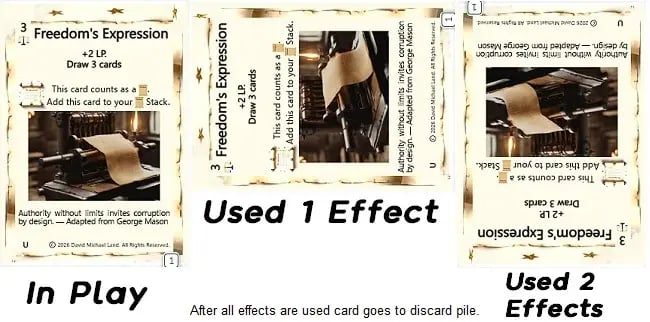
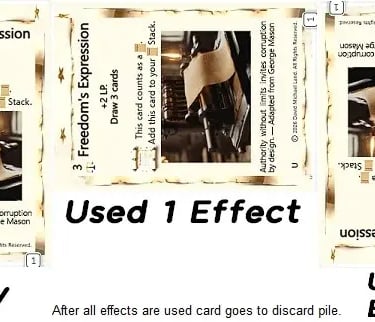
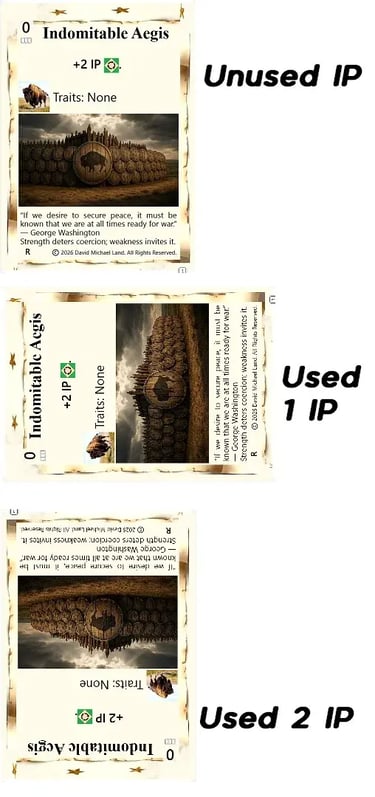
Used Effects: Cards that contain more than one effect track usage through physical card rotation. When the first effect on a card is used, rotate the card 90 degrees clockwise. The card remains in play. When the second effect is used, rotate the card 180 degrees, leaving it upside down. The card remains in play until all effects have been used. Cards that remain in play permanently, such as Pillars and Petitions, are not discarded after effects are used. All other cards are discarded after all effects on that card have resolved. Each effect resolves once and cannot be used again unless the card carries an Each Turn designation or the card text explicitly overrides discard, such as Exile. Rotation is the physical record of which effects remain available.
V
Victory Check: Occurs during the End Phase. If multiple conditions are met simultaneously, the Active Player wins.
Victory Conditions: Four ways to win. Liberty Point Victory requires opponent LP reduced to zero or below at End Phase. Attack Victory requires destroying all 3 opponent UAs, which wins instantly. Petition Victory requires 4 Petitions in play, 3 Scroll Pillars in play, and LP of 20 or greater at End Phase. Deck-Out Victory requires the opponent to be unable to draw during their Draw Phase because their Draw Pile is empty. If multiple victory conditions occur simultaneously, the Active Player wins.
Z
Zones: Draw Pile is in use and face down. Hand is in use and hidden. Discard Pile is in use and public. Pillar Zone is in play. Action Zone is in play. Petition Stack is in play. UA Area is in play. Exile Zone is out of play.
Terminology Lock
Revolt N Reign uses defined terms exactly as written in this Glossary. If two terms appear similar, only the Glossary-defined term has rules authority. Informal language has no mechanical effect.
Future Terms
This Glossary is designed to scale. New keywords, terms, and definitions introduced in future card sets will be added without restructuring existing entries.
Foundational Principle
The Founders understood that emergencies are the most common justification for the expansion of government power. History shows that powers granted temporarily during crisis often persist long after the crisis has passed.
Under the original constitutional framework, government exists to secure pre-existing rights, not to redefine, suspend, or ration them. Any exercise of authority that contradicts the Constitution's structure, limits, or guarantees was understood by the Founders to be without lawful force, regardless of justification or duration.
As James Madison understood, the accumulation of power under the pretext of necessity is the most reliable path to liberty's erosion. The Constitution was designed not for convenience in emergencies, but as a restraint precisely when power claims necessity.
Revolt N Reign reflects this principle: when authority relies on perpetual emergency, liberty no longer erodes suddenly. It erodes administratively.
Glossary Version 1.0.0 - Locked
© 2026 David Michael Land · All Rights Reserved · U.S. Copyright Registration No. 1-15189103691, effective June 20, 2026


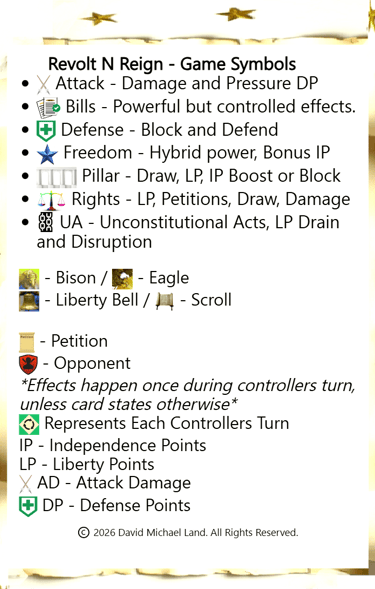
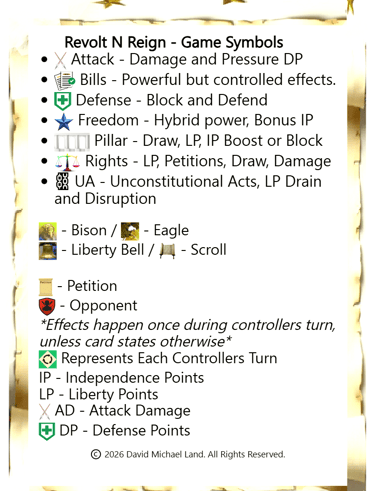
The Revolt N Reign Official Glossary defines every term, mechanic, and ruling in the game, from Attack Damage and Defense Points to Lock effects, Forced Resolution, and Petition Victory. Built as a tournament-ready reference, this glossary covers all seven card types, five turn phases, and the full 7-step Resolve Phase sequence. Whether you're a competitive player resolving edge cases at the table or a new player learning the difference between Liberty Points and Independence Points, this is your authoritative source.
REVOLT N REIGN Questions? We're here to help!
Email: info@revoltnreign.com
© David Michael Land 2025/2026 · All Rights Reserved · U.S. Copyright Registration No. 1-15189103691, effective June 20, 2026
The Revolution didn't surrender. Neither do you!
Revolt N Reign.


TCG Meta Strategy Game | Revolt N Reign
Defense Subset Freedom Subset Pillar Subset Rights Subset Symbols and UA Subset Scroll Defense Liberty Bell Defense Eagle Defense Bison Defense Scroll Attack Cards Liberty Bell Attack Eagle Attack Bison Attack RNR Quick Start Official RuleBook Glossary Rules What is Revolt N Reign About