Revolt N Reign Unconstitutional Acts & Symbols

Exposing the Corruption

Gulf of Tonkin Resolution of 1964
Intolerable Acts of 1774
Quartering Act of 1765
Navigation Acts of 1651-1773
Proclamation of 1763
Sedition Act of 1798
Stamp Act of 1765
Stamp Act of 1765
Sugar Acts of 1764
Sugar Acts of 1764
War Powers Resolution of 1973
FISA Act of 1978
FISA Act of 1978
Patriot Act of 2001
Patriot Act of 2001
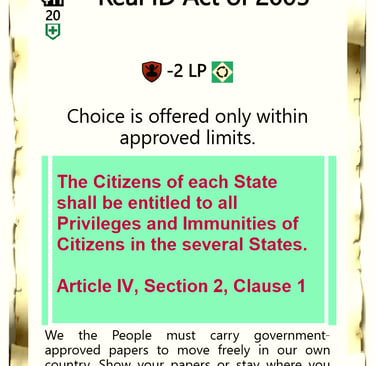
Real ID Act of 2005
Real ID Act of 2005
Federal Reserve Act of 1913
Espionage Act of 1917
Sedition Act of 1918
NDAA Indefinite Detention of 2012
Military Commissions Act of 2006
Executive Order 12333 of 1981
16th Amendment of 1913
14th Amendment of 1868
Executive Order 9066 of 1942
Coinage Act of 1873
Coinage Act of 1873
Alien Act of 1798
Alien Act of 1798
Rare Effect: Revealed in purchased editions

Unconstitutional Acts

Power Has Always Tested Liberty, and it still is. This Is Where That Test Begins.

Before the first card is drawn. Before the first IP is generated. Before either player has made a single decision, Three Unconstitutional Acts are already on the board.

Not placed by strategy. Not earned through play. Already there, the way corruption has always operated in the real world. Not announced. Not debated. Simply present, embedded in the structure of the match before anyone had a chance to object.

In Revolt N Reign, Unconstitutional Acts don't represent a hypothetical threat. They represent the actual condition every player enters the game inside of. The pressure is already applied. The corruption is already in play.

What you do about it, that's the game.

What Unconstitutional Acts Actually Are

Unconstitutional Acts are the living representation of government power operating beyond its constitutional limits.

Not a fantasy villain. Not an abstract obstacle. The specific, documented reality the Founders spent their entire political lives fighting, the moment a governing authority decides that its own judgment supersedes the law it was created to uphold, and acts accordingly. Taxation without representation. Quartering troops in private homes. Suspension of habeas corpus. Searches without warrants. The slow, deliberate erosion of the protections a free people built specifically to stop exactly this.

In Revolt N Reign, those acts arrive pre-installed on the battlefield because that is how they have always arrived in history, not through dramatic confrontation, but through quiet, institutional overreach that is already entrenched before most people realize it happened.

Each UA drains Liberty Points every turn. Not all at once. Steadily. Persistently. The way corruption has always operated, not in a single catastrophic moment, but across time, turn by turn, until the damage is impossible to ignore and far harder to reverse than it would have been to prevent.

Unconstitutional Acts pressure the battlefield.

Each one names a different dimension, because real government overreach has never been limited to a single method. Some UAs reshape the battlefield entirely. They alter the rules of engagement for as long as they remain in play, changing what is possible, what is accessible, what lines of play remain open.

Power that defines its own limits, as John Adams warned, eventually leaves liberty with none.

Ignore any one of them and the pressure compounds. What begins as a manageable drain becomes a structural disadvantage that affects every decision that follows.

The Three Responses, And What Each Costs

Every player in every match faces the same fundamental question the moment the game begins:

How do you respond to Unconstitutional Acts already in play?

There are three answers. None of them are free.

Confront them directly.

Liberty Bell Attack cards exist specifically to remove UAs from the battlefield. Rights cards can deal targeted damage. Freedom cards like Rosa Parks' Stand, Sam Adams' Passion, and Molly Pitcher's Cannon strike UAs with enough force to destroy them outright, with options to bypass Defense when the window is right.

Direct removal is the cleanest answer. Destroy all three UAs and the match ends immediately in Attack Victory, no LP threshold required, no End Phase condition, no waiting. The corruption is gone. Liberty is restored on this battlefield.

But direct removal costs IP. It costs turns. It costs cards that could have been building toward other victory paths. Every resource spent dismantling a UA is a resource not spent building your own position. Confronting corruption directly is the right answer. It is not always the fast one.

Contain the damage.

Bison Defense cards stabilize LP against the drain. Liberty Bell Defense cards reinforce UA positions to slow your opponent's removal sequences, exploiting the corruption's continued presence as pressure against the player trying to dismantle it. Scroll Defense cards protect the Petition structure developing behind the UAs still standing.

Containment isn't surrender. It's the recognition that not every battle is won in the first engagement, that sometimes the correct move is to absorb the pressure, maintain your position, and force your opponent to burn resources on a threat that isn't breaking you the way they planned.

The Founders didn't dismantle every act of overreach in a single confrontation. They held ground, protected their position, and chose their moments.

Adapt your strategy around them.

Some players don't remove UAs and don't simply absorb them, they build strategies that account for the pressure as a fixed condition and route around it entirely. Eagle Deck-Out builds can pursue Deck-Out Victory without ever directly engaging the UAs across the table. Scroll Petition builds can reach their threshold while the UAs are still standing. Bills cards can alter the legislative landscape of the match regardless of what corruption remains on the board.

The UAs are still draining LP. The pressure is still there. But a player who reaches their victory condition first wins the match regardless of how many Unconstitutional Acts were never removed.

Liberty doesn't always win by dismantling every obstacle. Sometimes it wins by completing what it came to accomplish before the obstacles can finish their work.

The Strategic Depth Nobody Sees Until It's Too Late

Here is what separates players who understand Unconstitutional Acts from players who are still figuring them out:

The UAs on your side of the board are not your only problem.

Three UAs enter play on your side. Three enter play on your opponent's side. Your opponent's UAs are draining your LP every turn. Your UAs are draining their LP every turn. The match is not a one-directional pressure test, it is a simultaneous contest of who manages the corruption on both sides of the board more effectively.

A Liberty Bell Attack player hunting your UAs is also exposing their own to your counter-pressure. A player ignoring their own defensive positioning to accelerate UA removal is a player whose LP may collapse before the removal sequence completes. A player who successfully defends their UAs against your removal attempts has turned your offensive resources into wasted turns, but their UAs are still costing them LP too.

Every decision made about Unconstitutional Acts affects both sides of the board simultaneously. The player who sees the full picture, their UAs, their opponent's UAs, the LP implications of every line of play across both, is the player operating at the level Revolt N Reign was designed for.

The Historical Weight Behind the Mechanic

In Revolt N Reign, built on the Declaration of Independence, the original Constitution for the united States, the 10 original Bill of Rights, and the Federalist Papers, Unconstitutional Acts are not a game design abstraction.

They are the specific category of government action the Founders built every legal protection to prevent, and spent their lives fighting to reverse when prevention failed.

The Declaration names them explicitly: a history of repeated injuries and usurpations, all having in direct object the establishment of an absolute Tyranny. The Constitution structures the limits specifically so those acts would have no legal standing. The Bill of Rights names the protected categories precisely because those were the rights already being violated when the document was written.

The Founders understood something every player in Revolt N Reign eventually learns:

Unconstitutional Acts do not announce themselves as threats to liberty. They present themselves as necessary measures, reasonable adjustments, temporary exceptions, and they drain freedom steadily, quietly, and persistently until someone decides the cost of confronting them is lower than the cost of enduring them.

On this battlefield, that moment arrives every match. Three acts of corruption, already in play, already applying pressure.

The founding documents gave you the tools. The question has always been the same one:

What are you going to do about it?

Who Masters Unconstitutional Acts

Mastery of Unconstitutional Acts doesn't belong to the player who removes them fastest or the player who ignores them most efficiently.

It belongs to the player who understands what they represent, on the battlefield and in the history behind the game, and makes every decision about them with full awareness of both.

The one who knows when the corruption needs to be confronted directly and when containing it serves the strategy better. Who reads the LP drain across both sides of the board and understands exactly how many turns remain before the pressure becomes unsustainable. Who uses Freedom cards not as reflexive responses but as precisely timed interventions, Rosa Parks, Samuel Adams, Harriet Tubman, deployed at the exact moment the battlefield demands exactly what they deliver.

Who never forgets, through every tactical decision, what the Unconstitutional Acts actually represent, and what it cost the people who first stood against them to make those costs mean something.

If you understand that the game does not begin when the first card is played, It begins the moment three acts of corruption take their place on the board.

And the match ends when someone decides they have had enough.

The Founders didn't inherit a free country.
They inherited a board already full of Unconstitutional Acts.
They looked at the pressure already applied, the LP already draining,
*the corruption already entrenched, *

and they played their hand anyway.

Your turn.
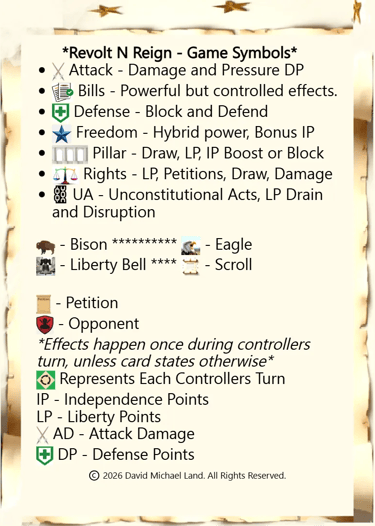
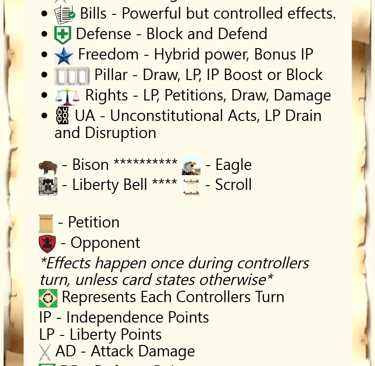
Character Symbols for Revolt N Reign

Revolt N Reign Unconstitutional Acts are the only cards in the game that enter play before the match begins, pre-installed on the battlefield the way real government overreach has always operated: already entrenched before anyone had a chance to object. All 23 UA cards are named for real historical acts of government overreach, from the Stamp Act of 1765 to the Patriot Act of 2001. Each one drains Liberty Points every turn and reshapes the battlefield until it's removed. Liberty Bell Attack cards deal direct UA damage. Freedom cards like Rosa Parks' Stand and Sam Adams' Passion can bypass Defense entirely. Or build toward Scroll, Eagle, or Bison victory while the UAs keep applying pressure. For parents, patriots, and players who want a game grounded in real American history, the Unconstitutional Acts are the most historically authentic mechanic ever designed for a trading card game.