Revolt N Reign Rights Cards
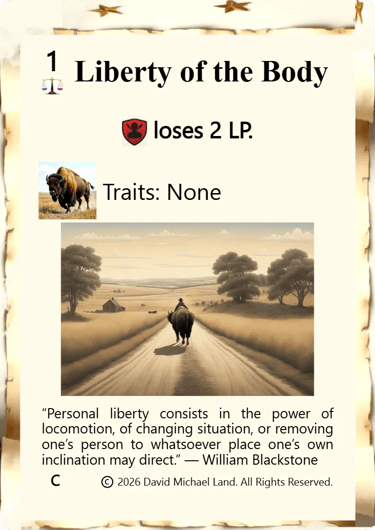
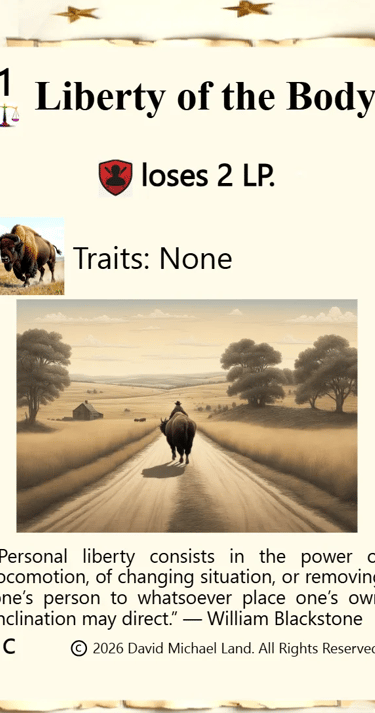
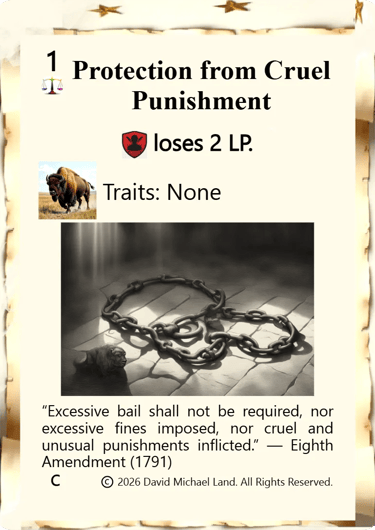
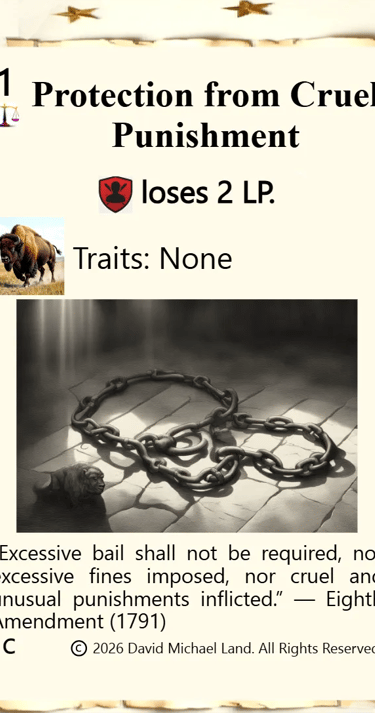
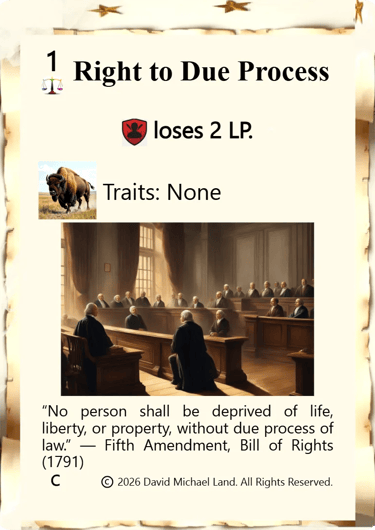
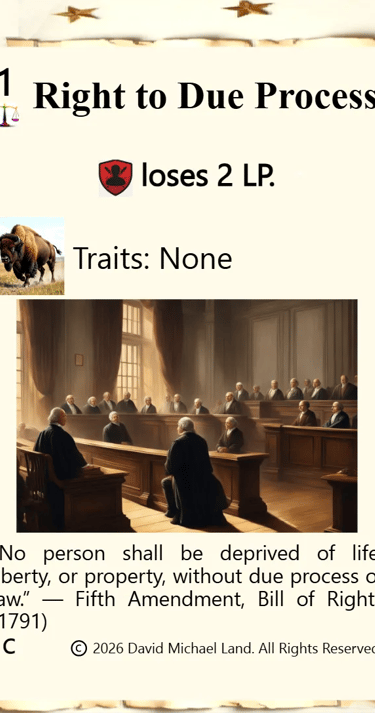
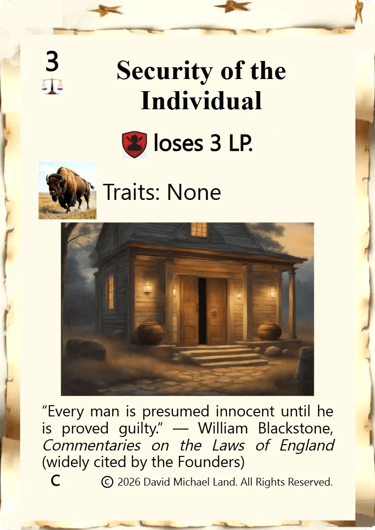

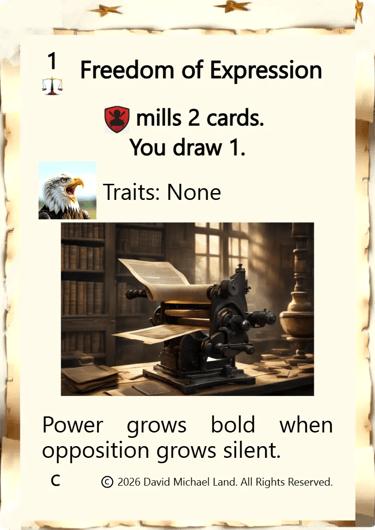
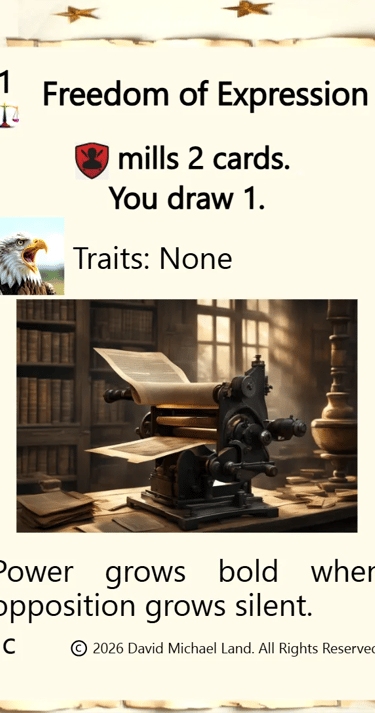
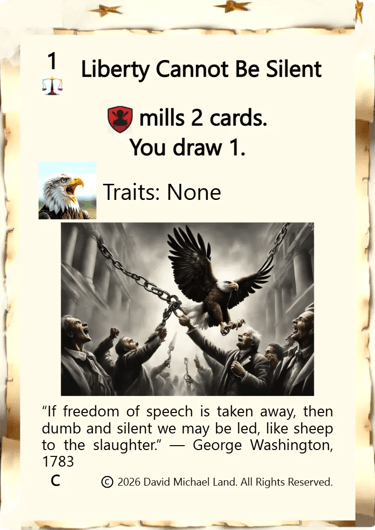
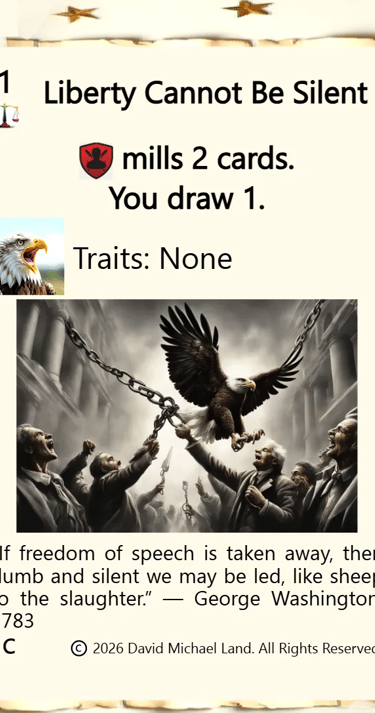




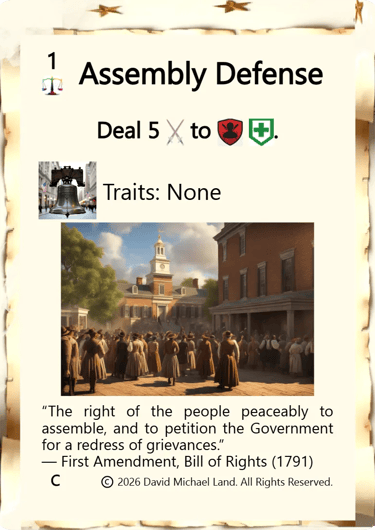
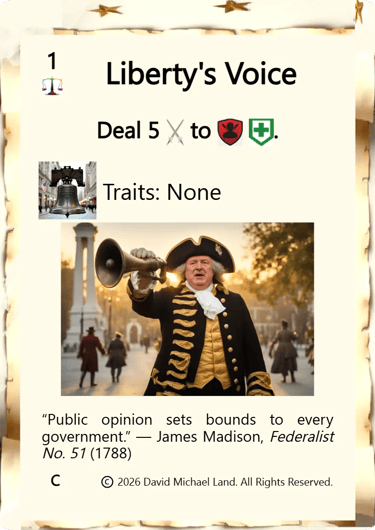
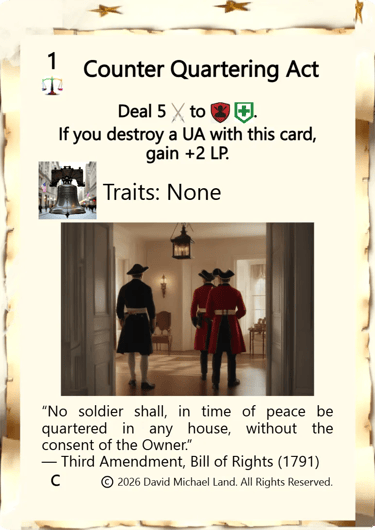
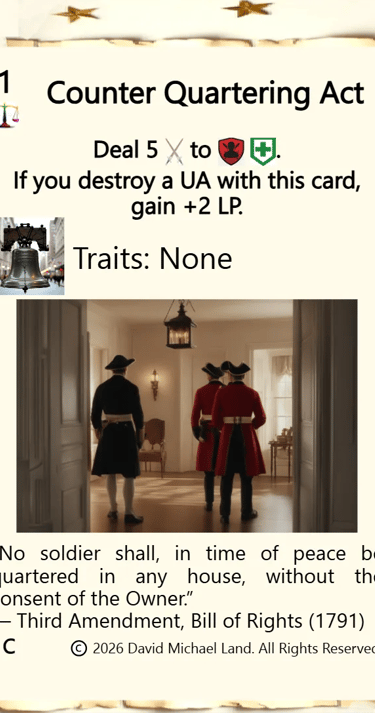
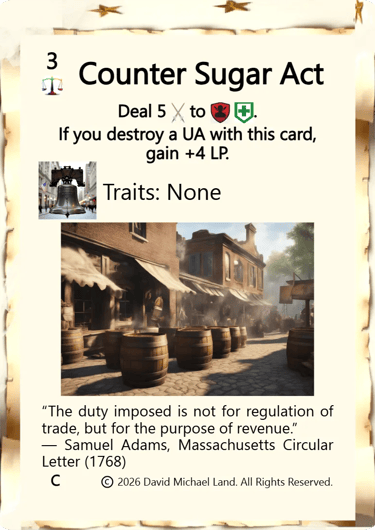
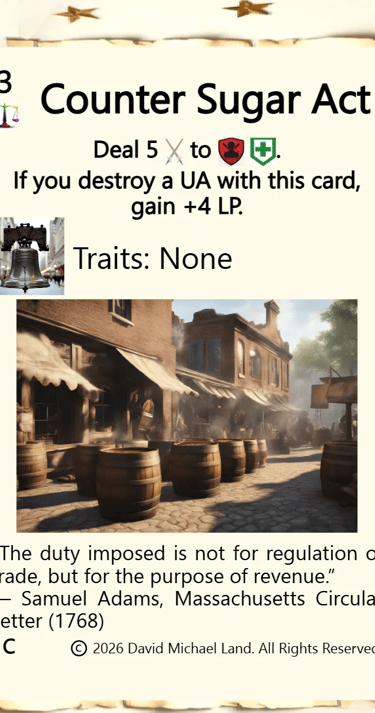


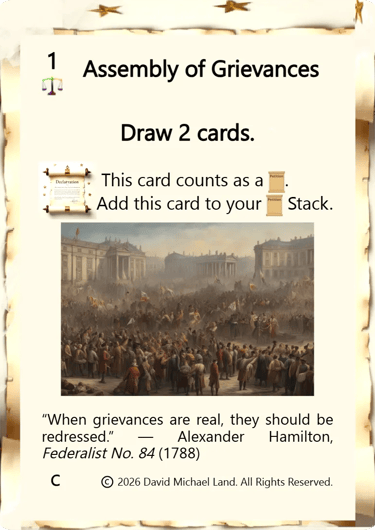
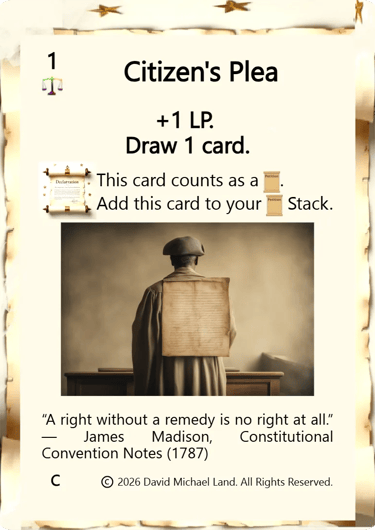

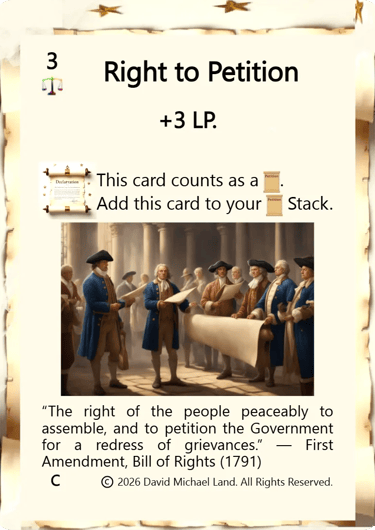
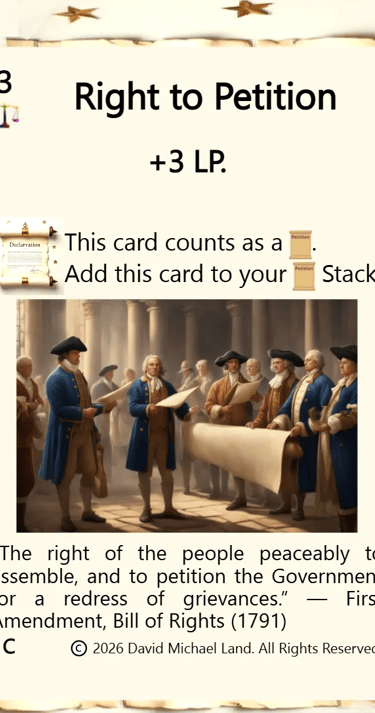
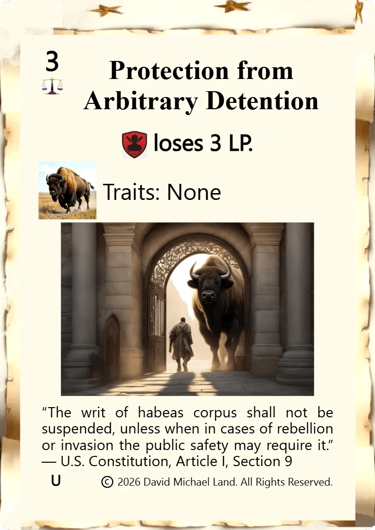


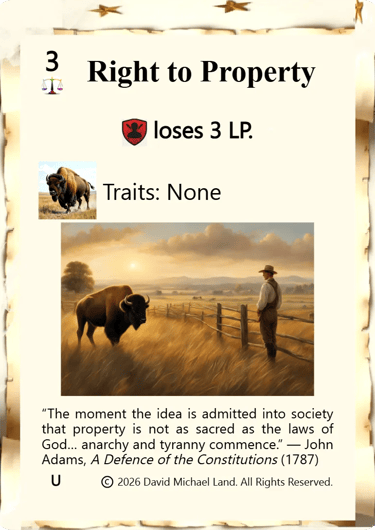
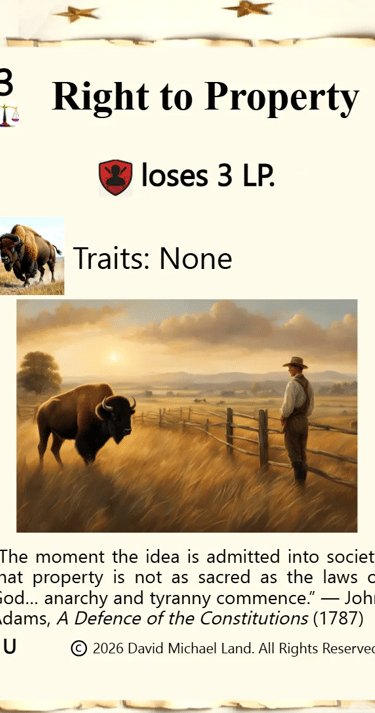
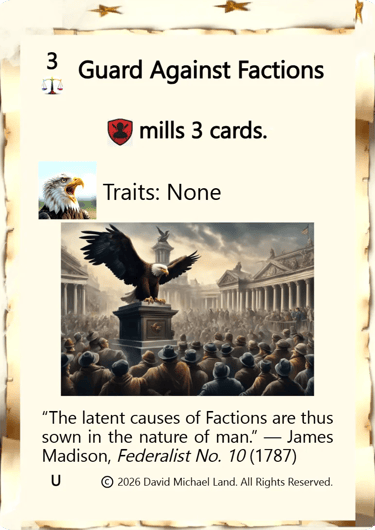
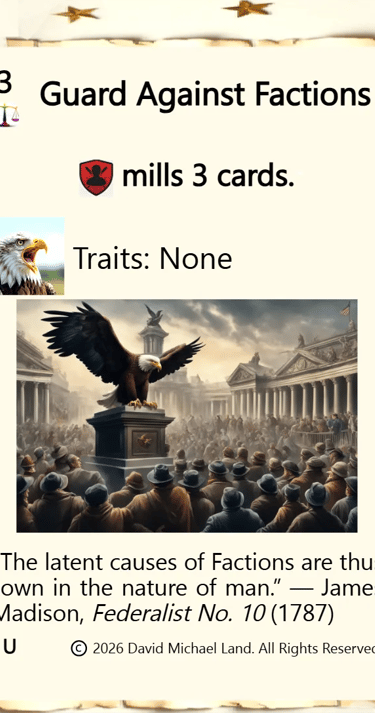
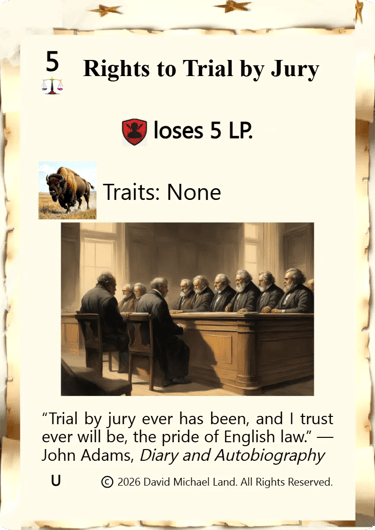



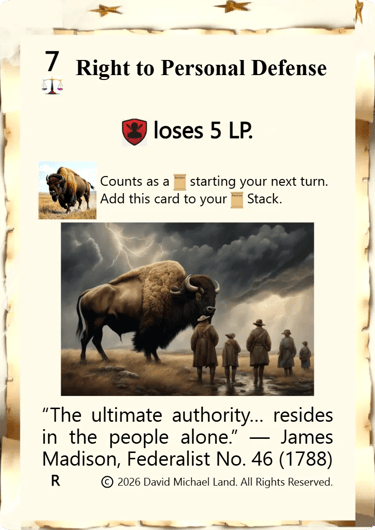
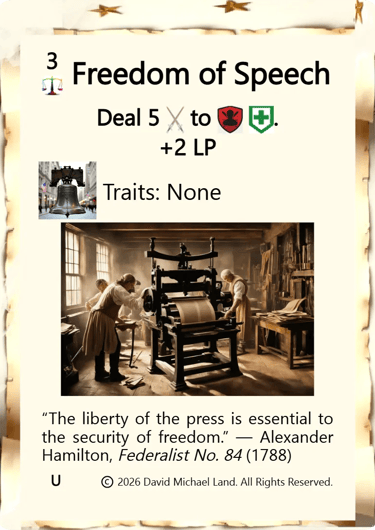





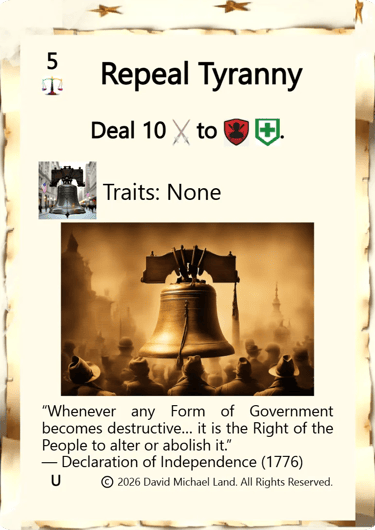



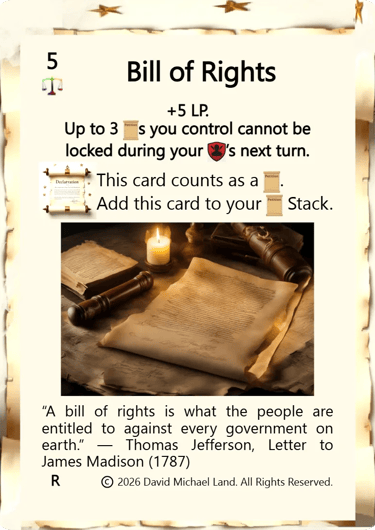
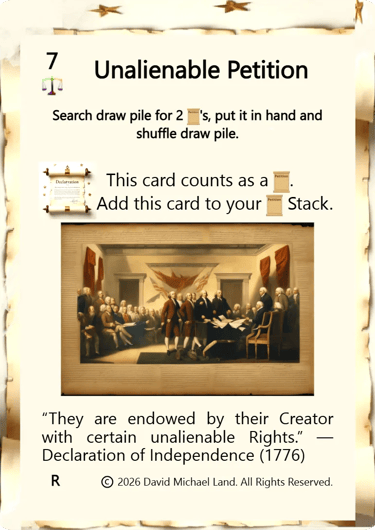






The artwork in Revolt N Reign will use a combination of historically sourced images licensed for free modification, commercial use, and sharing, alongside original illustrations commissioned from independent artists. Black and white historical photography will appear on cards where the source material dates to that era, a deliberate choice that connects the card directly to the period it documents. Original color illustrations are being added as funding allows. Every image in the game will be either historically sourced under commercial license or created by a human artist. No machine-generated images will remain in the final published set. This process will take some time. Thank you for your patience.
Rights
Rights Are Not Requests. They Are Not Negotiable. They Are Not Optional.
Every founding document in Revolt N Reign encodes the same foundational truth, that certain rights exist not because a government granted them, but because no government has the authority to take them away. The Declaration declared them unalienable. The Constitution structured their protection. The Bill of Rights named them explicitly so that no future authority could pretend they were ambiguous.
The Rights subset puts those principles into play. One card. One resolution. One moment that changes the state of the battlefield.
The Rights subset is the most tactically immediate card group in the game. Not an engine. Not a structure. Not a resource base. Rights cards are precision instruments, deployed at the exact moment a match requires intervention, resolved completely, and discarded. One play. Full effect. The battlefield shifts.
Every Rights card asks the same question the Founders asked:
What does liberty demand right now, and are you willing to act on it?
The Mechanic That Defines the Subset
Rights cards resolve once and move to the discard pile. There is no recursion, no return, no second opportunity with the same card. Every play is permanent and deliberate, exactly like every right the Founders encoded into law.
Rights weren't drafted to be temporary. They weren't written with expiration dates or conditional clauses that let authority reclaim them when convenient. They were declared absolute, documented precisely, and defended at cost, because the Founders understood that a right exercised halfway is a right already being surrendered.
On this battlefield, that principle becomes a mechanic. You don't get the card back. Make the play count.
One important exception exists within the subset, Petition cards. While standard Rights cards resolve and discard, Petitions remain in play unless specifically removed or exiled by a card effect. For players building toward Scroll Victory, Rights-branch Petition cards advance the stack while delivering immediate tactical effects. The right doesn't disappear, it becomes part of the permanent record.
Four Branches. Four Expressions of the Same Truth.
The Rights subset operates across all four strategic branches, Scroll, Liberty Bell, Eagle, and Bison, each delivering a distinct tactical function aligned with both the branch's strategic identity and the historical rights those cards represent.
Scroll Rights, Petition and Assembly
Scroll-branch Rights cards are the Petition engine of the entire game. Every card in this branch counts as a Petition, adds directly to your Petition Stack, and delivers an immediate tactical effect that compounds the value of the play.
Assembly of Grievances, Draw 2 cards. Petition added.
Citizen's Plea, +1 LP, draw 1 card. Petition added.
Anti-Surveillance Plea, Look at the top 4 cards of your Draw Pile, reorder them. Petition added.
Right to Petition, +3 LP. Petition added. Grounded in the First Amendment itself.
Freedom's Expression, +2 LP, draw 3 cards. Petition added.
Counter Espionage Act, Your opponent cannot lock your Petitions until your next turn. Petition added.
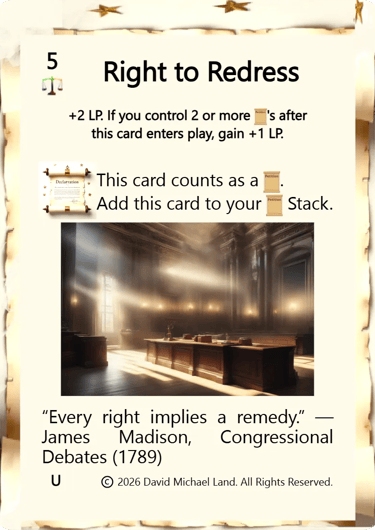
Right to Redress, +2 LP. Control 2 or more Petitions when this enters play and gain +1 LP additional. Petition added.
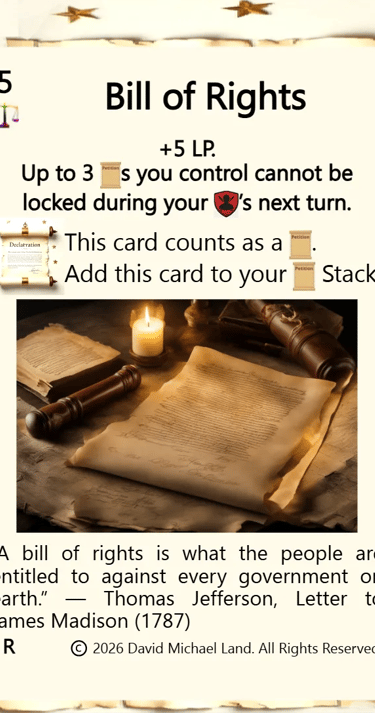
Bill of Rights, +5 LP. Up to 3 Petitions you control cannot be locked during your opponent's next turn. Petition added.
Unalienable Petition, Search your Draw Pile for 2 Petitions, put them in hand, shuffle. Petition added.
The Scroll Rights branch doesn't just advance Petition Victory, it accelerates, protects, and refuels the entire structure simultaneously. Every card in this branch does two things at once: delivers an immediate tactical effect and locks in another step toward the threshold that ends the match.
"They are endowed by their Creator with certain unalienable Rights.", Declaration of Independence, 1776
That's not flavor text on Unalienable Petition. That's the entire branch's philosophy made mechanical.
Liberty Bell Rights, Strike and Reclaim
Liberty Bell-branch Rights cards are the most aggressive single-resolution effects in the subset. Every card in this branch deals damage to opponent Defense Points, and several carry conditional bonuses that trigger when those strikes destroy a UA.
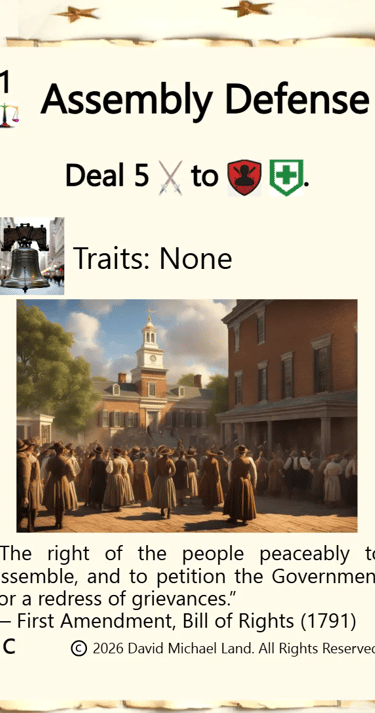
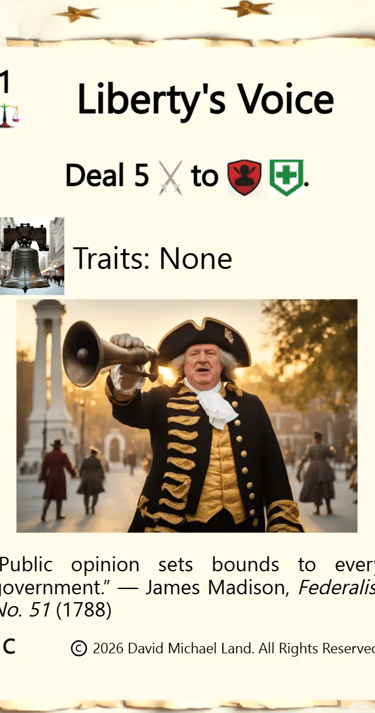
The base branch, Assembly Defense, Liberty's Voice, deal 5 damage to opponent DP. No conditions. No setup. Immediate, clean pressure on the defensive structure your opponent has built.
The branch escalates through historical grievances made mechanical:
Counter Quartering Act, 5 damage to opponent DP. Destroy a UA and gain +2 LP.
Counter Sugar Act, 5 damage to opponent DP. Destroy a UA and gain +4 LP.
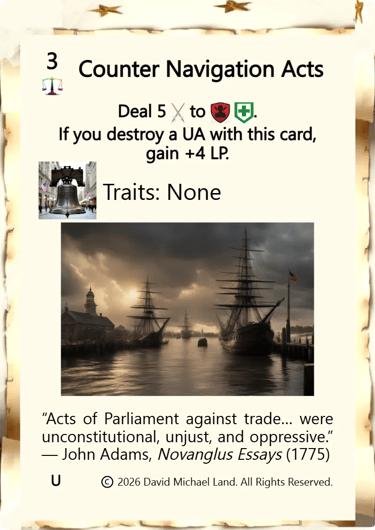
Counter Navigation Acts, 5 damage to opponent DP. Destroy a UA and gain +4 LP.
Freedom of Speech, 5 damage to opponent DP, +2 LP. Grounded in Hamilton's Federalist No. 84.
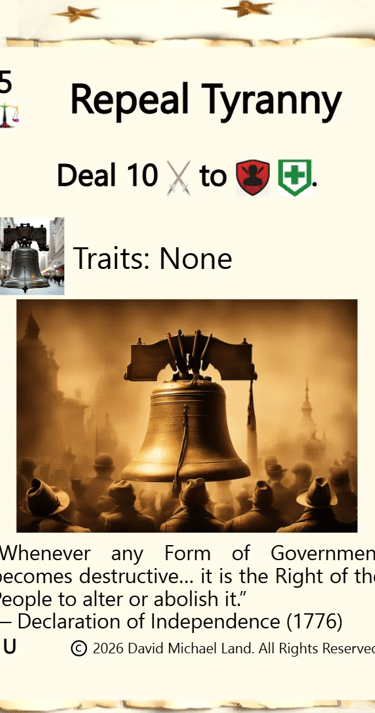
Repeal Tyranny, 10 damage to opponent DP. Built on the Declaration's most explicit statement of the people's right to dismantle destructive government.
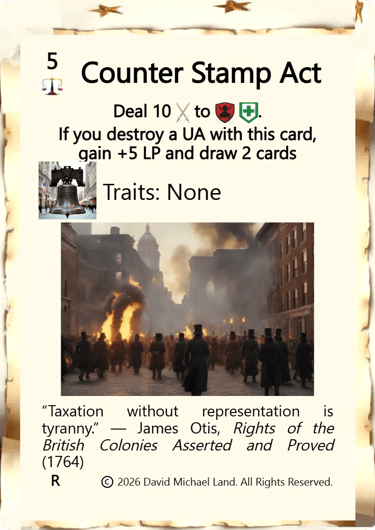
Counter Stamp Act, 10 damage to opponent DP. Destroy a UA and gain +5 LP plus draw 2 cards.
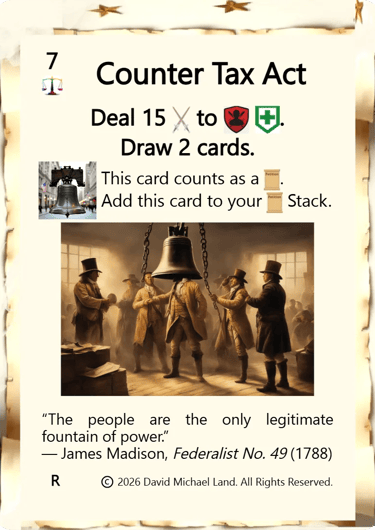
Counter Tax Act, 15 damage to opponent DP, draw 2 cards. Counts as a Petition.
The Liberty Bell Rights branch names every act of historical overreach the Founders specifically fought against, the Stamp Act, the Sugar Act, the Navigation Acts, the Quartering Act, and turns each one into a tactical tool for dismantling the corruption those acts represented. Not metaphorically. By dealing damage to the defensive structures protecting your opponent's Unconstitutional Acts and rewarding you directly when those Acts fall.
"Taxation without representation is tyranny.", James Otis, 1764
These cards aren't named after historical grievances for atmosphere. They're named after them because the rights they represent were worth fighting for then, and the damage they deal reflects exactly what it cost to establish them.
Eagle Rights, Information and Erosion
Eagle-branch Rights cards operate on a principle the Founders understood better than almost anyone: a people who lose access to information lose the ability to govern themselves.
Every card in this branch mills your opponent's Draw Pile, removing cards from their future before they can use them, while several simultaneously draw cards for you, compounding the intelligence advantage in both directions at once.
Freedom of Expression, Liberty Cannot Be Silent, Liberty of Conscience, Mill 2, draw 1. Three cards grounded in Washington, Madison, and the principle that silence in the face of power is complicity in its expansion.
Watchful Liberty, Mill 3. Built on the foundational civic principle that the price of liberty is eternal vigilance.
Free Exchange of Ideas, Mill 3, draw 1. Washington's conviction that truth prevails only where it is actively brought to light.
Guard Against Factions, Mill 3. Madison's Federalist No. 10, the latent causes of faction are sewn into human nature itself, and must be watched.
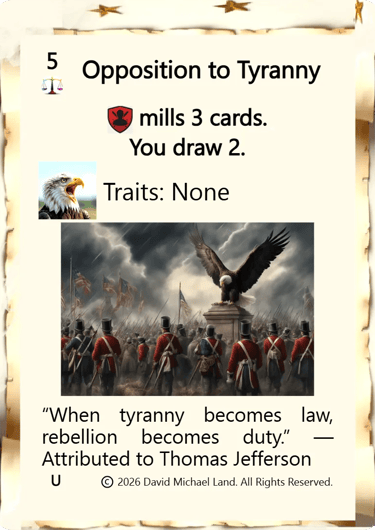
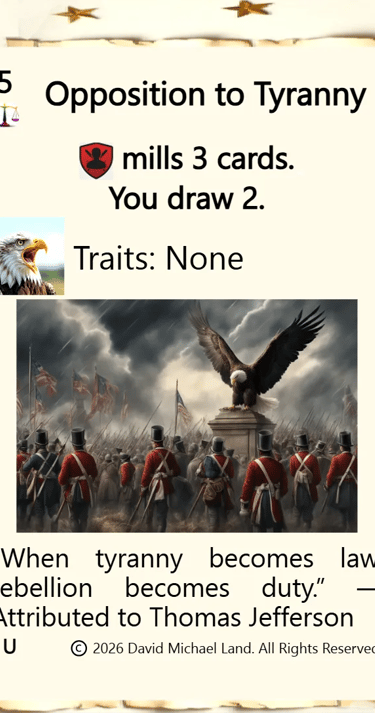
Opposition to Tyranny, Mill 3, draw 2. When tyranny becomes law, rebellion becomes duty.
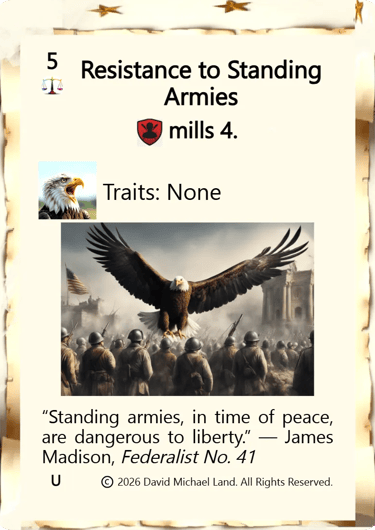
Resistance to Standing Armies, Mill 4. Madison's warning that standing armies in peacetime are dangerous to liberty, and that the Draw Pile equivalent is an opponent's uncontested card depth.
Eternal Vigilance, Mill 2. Counts as a Petition. Jefferson's conviction that a well-informed people alone can be trusted with their own government, here that vigilance advances your Petition Stack while eroding your opponent's strategic resources.
Eagle Rights don't attack the board. They attack the future, steadily, turn by turn, card by card, until your opponent reaches their Draw Phase and finds the answers they needed are already gone.
"Power grows bold when opposition grows silent.", Freedom of Expression
The Eagle Rights branch makes sure that never happens on your side of the table.
Bison Rights, The Personal Rights That Cannot Be Surrendered
Bison-branch Rights cards are the most direct expression of individual liberty in the entire game, each one named for a right the Founders encoded specifically because unchecked authority had already violated it, and a free people refused to let it happen again.
Every card in this branch deals direct LP damage to your opponent. Not Defense damage. Not UA damage. Direct Liberty Point reduction, the clearest expression on the battlefield of what happens when individual rights are stripped away from a person with no recourse.
Liberty of the Body, Opponent loses 2 LP. Blackstone's definition of personal liberty as the power to move freely, without arbitrary restriction.
Protection from Cruel Punishment, Opponent loses 2 LP. The Eighth Amendment, verbatim.
Right to Due Process, Opponent loses 2 LP. The Fifth Amendment, no person deprived of life, liberty, or property without due process.
Security of the Individual, Opponent loses 3 LP. Blackstone's presumption of innocence, cited by the Founders explicitly.
Protection from Arbitrary Detention, Opponent loses 3 LP. The habeas corpus protection from Article I, Section 9.
Right to Property, Opponent loses 3 LP. John Adams' warning that the moment property is no longer sacred, anarchy and tyranny begin simultaneously.
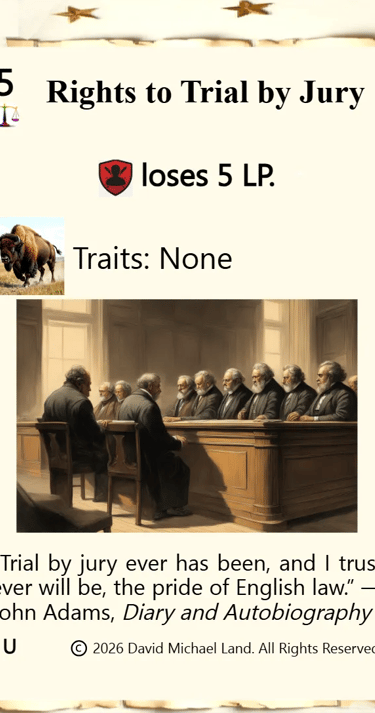
Rights to Trial by Jury, Opponent loses 5 LP. Adams' conviction that jury trial was and must remain the pride of law.
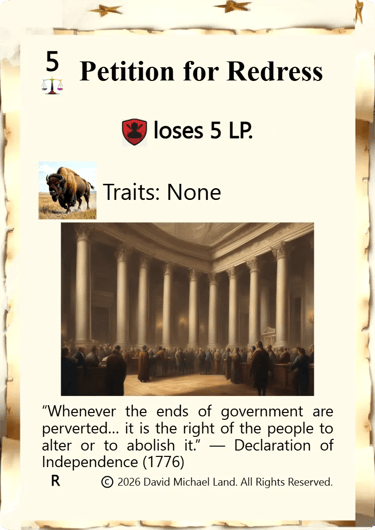
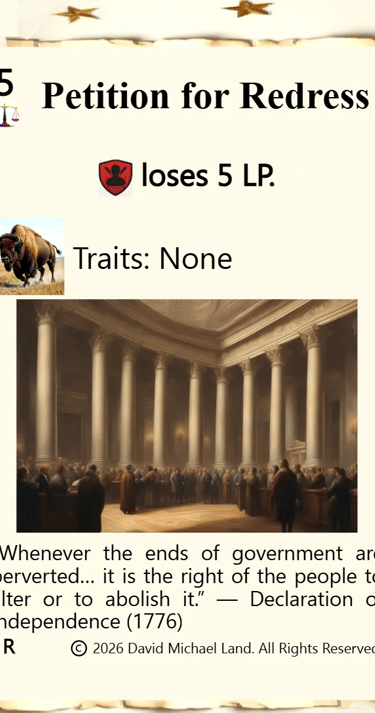
Petition for Redress, Opponent loses 5 LP. The Declaration's assertion that when government perverts its ends, the people have the right to alter or abolish it.
Right to Personal Defense, Opponent loses 5 LP. Counts as a Petition starting your next turn. Madison's Federalist No. 46, the ultimate authority resides in the people alone.
The Bison Rights branch reads like a constitutional indictment, because that's exactly what it is. Every card names a right that was violated by the authority the Founders were fighting, and every card drains the Liberty Points of the player representing unchecked power on this battlefield.
These aren't game mechanics dressed in historical language. They are historical grievances that became law, and on this battlefield, they cost your opponent exactly what refusing them cost the people who first demanded them.
Precision Over Volume
Rights cards are not designed to anchor a deck. They are designed to decide specific moments within one.
The player who draws Counter Stamp Act at 10 IP with a vulnerable UA across the table doesn't need a strategy, they need to play the card. Ten damage to opponent DP, UA destroyed, +5 LP gained, 2 cards drawn. One play. Four outcomes. The match has just shifted.
The player who draws Unalienable Petition two turns from their Scroll Victory threshold doesn't need to recalculate, they search their Draw Pile for 2 Petitions, put them in hand, and close the gap that was going to cost them two more turns.
The player who draws Right to Personal Defense when their LP is borderline gets 5 LP damage on their opponent and a Petition that starts counting next turn, two problems solved with one card that costs 7 IP and resolves completely.
Rights cards don't replace strategy. They execute it at the moments strategy alone can't reach.
The Historical Weight Behind the Subset
In Revolt N Reign, built on the Declaration of Independence, the original Constitution for the united States, the 10 original Bill of Rights, and the Federalist Papers, every card in the Rights subset carries language that was written, argued, ratified, and defended at cost by people who understood what happened when these protections didn't exist.
The Quartering Act happened. The Stamp Act happened. Arbitrary detention happened. Cruel punishment happened. Property seizure happened. Trials without juries happened. The absence of a free press happened. The Founders didn't invent these rights, they recognized them as pre-existing and built every legal structure in the founding documents specifically to make their violation as difficult, as costly, and as publicly visible as possible.
On this battlefield, those rights become tools. Each one deploys exactly the effect it was designed to deliver in the real world, protection, redress, information, resistance, and the direct assertion that liberty is not a privilege the government extends. It is a condition the people defend.
Who Masters the Rights Subset
Every player uses Rights cards. Not every player uses them well.
The ones who do aren't the ones who play them as soon as they draw them. They're the ones who hold Bill of Rights until the turn before their Petition threshold, when locking 3 Petitions for an entire turn may be the difference between Scroll Victory and another few rounds of reassembly. Who keep Counter Stamp Act until a UA is within 10 damage of destruction and the board can absorb what comes next. Who play Eternal Vigilance not just for the mill but for the Petition it adds, because they already counted how many they need and this is the one that closes it.
Rights cards reward the player who knows exactly what the match needs at exactly the moment it needs it.
If you understand that timing is a weapon, that the right play at the wrong moment is still the wrong play, and if you believe that the rights encoded in these cards were worth everything it cost to establish them:
The Rights subset wasn't designed to fill out your deck.
It was designed for the player who knows when to use it.
They wrote these rights down because power had already violated them.
They ratified them because words without law are just words.
They defended them because law without enforcement is just paper.
One card. One resolution. One right exercised at exactly the right moment.
That's all liberty has ever required.
Rights cards are the tactical precision layer of every Revolt N Reign deck, 36 one-resolution cards divided across Scroll, Liberty Bell, Eagle, and Bison branches, each named for a real right the Founders encoded into American law. Scroll Rights advance your Petition Stack while refueling your hand and protecting your structure. Liberty Bell Rights deal DP damage and reward UA destruction with LP recovery. Eagle Rights mill your opponent's Draw Pile while building your own card advantage. Bison Rights drain LP directly, the most immediate individual liberty expression in the game. No Rights card returns to your hand. Every play is permanent. For players who understand that timing is strategy, the Rights subset is where matches are decided.
REVOLT N REIGN Questions? We're here to help!
Email: info@revoltnreign.com
© David Michael Land 2025/2026 · All Rights Reserved · U.S. Copyright Registration No. 1-15189103691, effective June 20, 2026
The Revolution didn't surrender. Neither do you!
Revolt N Reign.


TCG Meta Strategy Game | Revolt N Reign
Defense Subset Freedom Subset Pillar Subset Rights Subset Symbols and UA Subset Scroll Defense Liberty Bell Defense Eagle Defense Bison Defense Scroll Attack Cards Liberty Bell Attack Eagle Attack Bison Attack RNR Quick Start Official RuleBook Glossary Rules What is Revolt N Reign About